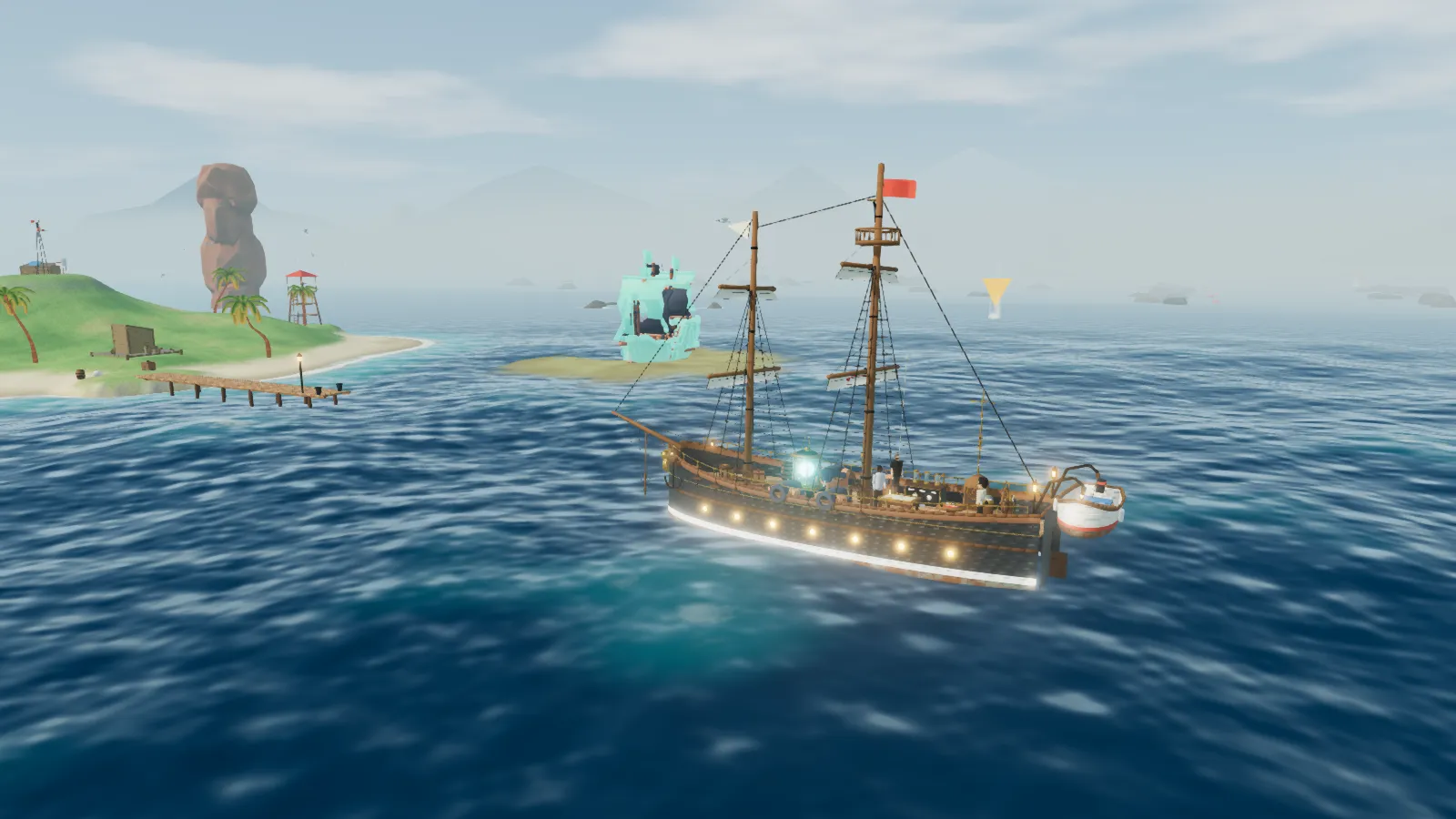
The Living Ship.
A pirate adventure that shows what an AI OS is. The Oracle is the model. The ship is the harness. You build it, voyage by voyage.
Free, no account. Best on a computer with a keyboard.
A clever model is not a working system
The Northlight lighthouse has gone dark. Your ship has an untested AI mind, an old chart and a crew waiting for orders. Sail it, tell it what is true, connect its tools, and decide what it may do on its own.
The model can only talk
At the start the Oracle can reason and plan a route, but it cannot touch the wheel, and it only knows last season's chart.
The harness makes it useful
Tools, context, memory, checks and permissions are what turn a clever voice into a crew member you can trust with the ship.
You fit it piece by piece
Twelve upgrades across six voyages. Each one is a layer of a real AI system, and each card says what it means in real life.
What you will learn
- Voyage 1
The Silent Lighthouse
Context, tools, memory and testing
- Voyage 2
The Phantom Fleet
Verification
- Voyage 3
The Forged Signal
Trusted inputs and permissions
- Voyage 4
The Drift
Memory upkeep and limited permissions
- Voyage 5
The Refit
The harness is the product; the model is swappable
- Voyage 6
The Unbound
Every layer at once
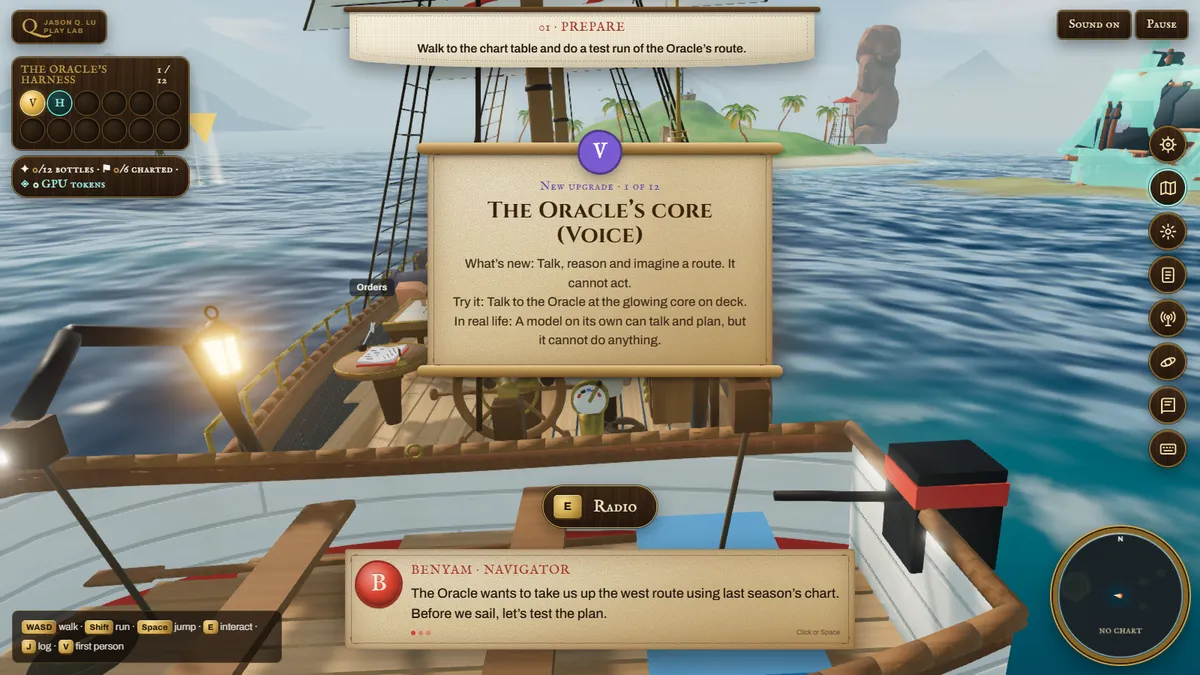
Every upgrade explains itself
Each part you fit comes with a card: what is new, how to try it, and what it means in a real AI system. Sound on if you can; the crew talk you through it.
- WASD walk
- Shift run
- Space jump
- E interact
- J log
- V first person
Your progress saves in this browser. The first load downloads the ship, the islands and the crew.
Five versions in two weeks
It started as a pixel platformer about a brain in a jar. The lesson never changed; the world around it did. Every version still plays: open any card. The older ones are kept exactly as they were.
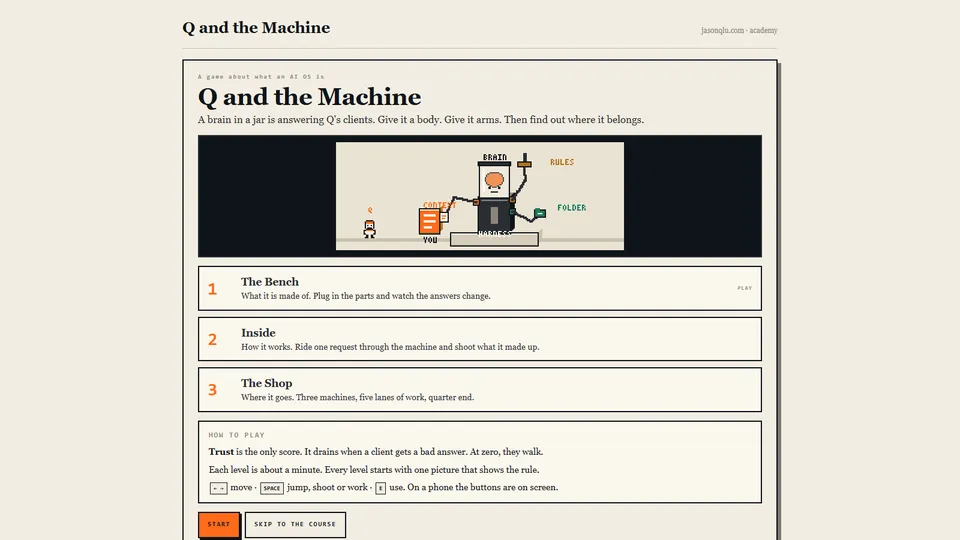
Version 114 Sep
Q and the Machine
A pixel platformer for the AI OS course. A brain in a jar answers Q's clients; you give it a body, then arms. Three one-minute levels.
What stayedThe idea: the AI is a brain, and the harness is its body.
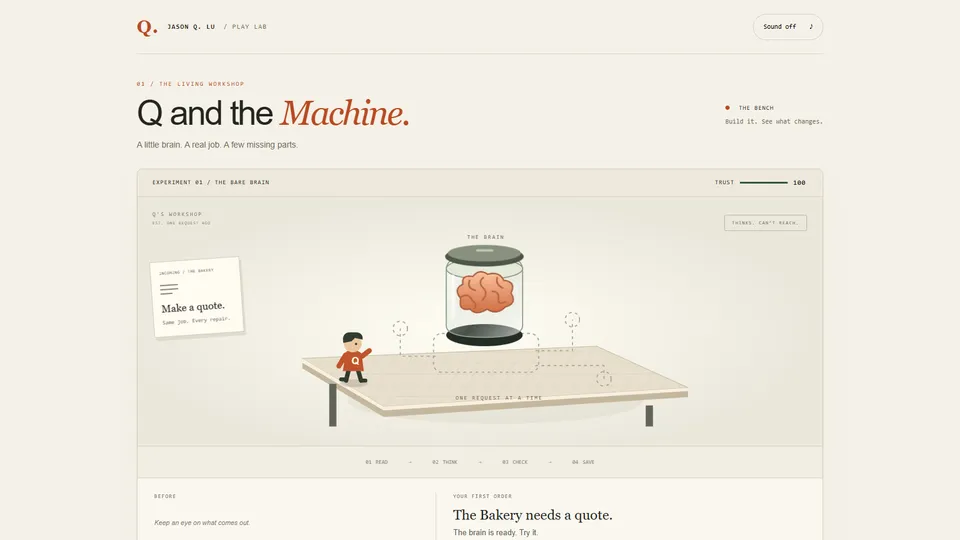
Version 215 Sep
ExperimentThe living workshop
One room, one brain on a bench, one bakery order. Every repair changes the answer in front of you.
What stayedLearning by watching the output change. The room itself was set aside for the platformer.
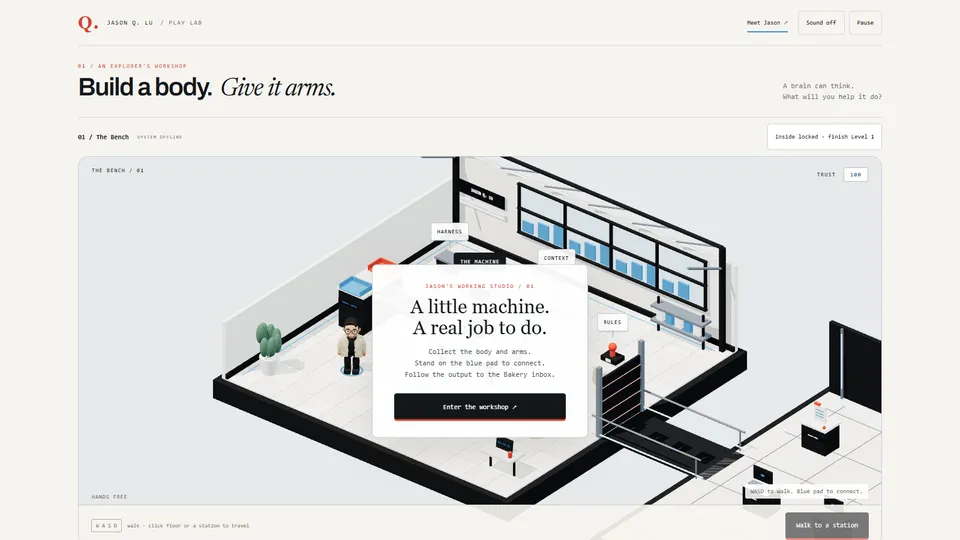
Version 315 to 16 Sep
The 3D workshop
The first 3D version. Walk an isometric studio and carry the body and arms to the machine, through three connected rooms.
What stayedA world you walk around, and Jason's figure, which today's game still uses.
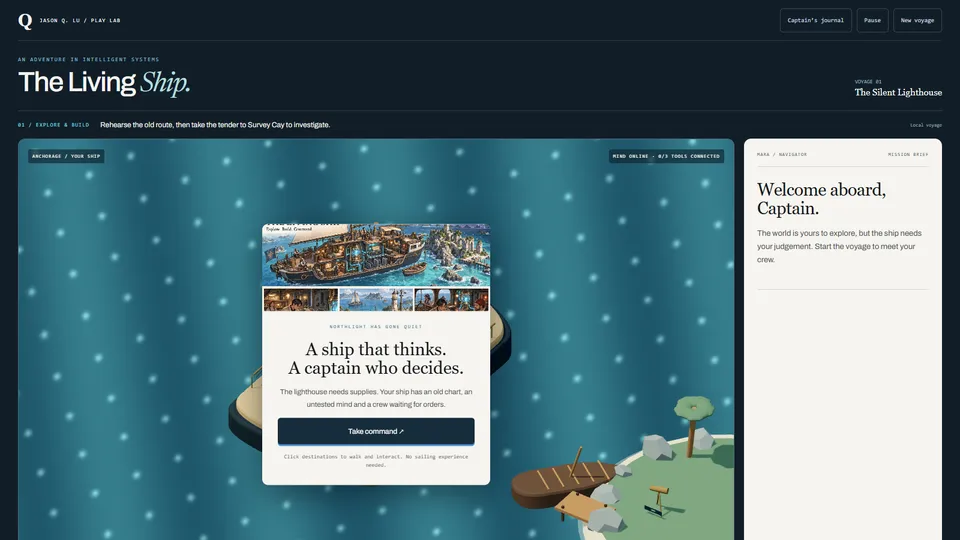
Version 426 Sep
The Living Ship, first voyage
A different angle. Jason wasn't happy with where the 3D workshop was going, so the machine became a ship with a thinking mind: click to walk, take the tender ashore, gather evidence, connect tools, set standing orders.
What stayedAll of Voyage 1: the dark lighthouse, Survey Cay, the wreck, the pilot's notes.
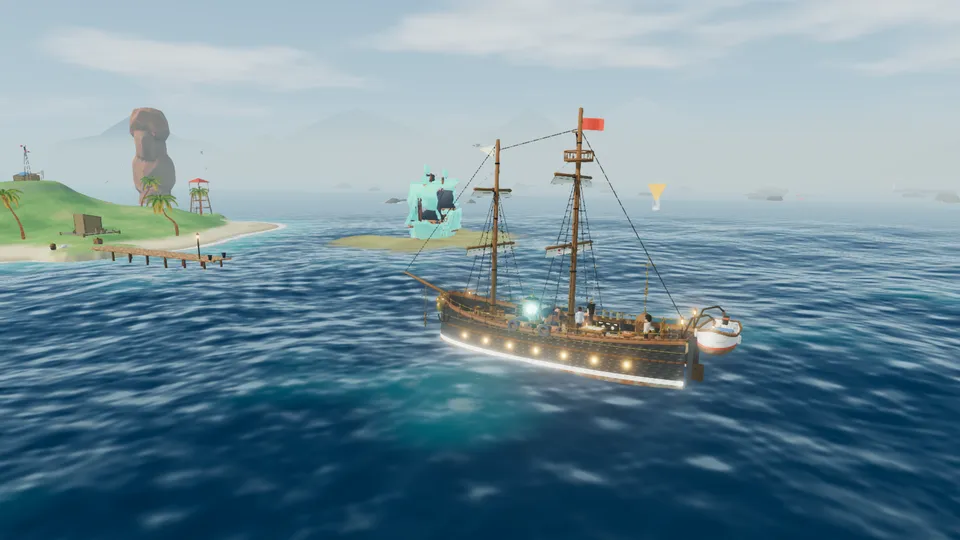
Version 526 to 28 Sep
NowThe Living Ship
Rebuilt as a realtime game: walk the deck, take the wheel, six voyages and twelve upgrades.
- 26 Sep: the realtime rebuild, the campaign and a second ship
- 27 Sep: the Oracle, the crew, the story and the islands
- 28 Sep: playtest fixes, 418 recorded voice lines, music, and this site
Common questions
- What is The Living Ship?
- A free browser game by Jason Q. Lu about how AI systems are built. You captain a ship whose AI mind, the Oracle, starts with only a voice. Over six voyages you give it tools, context, memory, checks and permissions, and see why each one matters.
- Does the game use a real AI?
- No. The Oracle and the crew are scripted, and the game does not call an AI model while you play. Their voices were recorded in advance with an open text-to-speech model. It teaches how AI systems are put together, not how to use one.
- Is it free, and do I need an account?
- It is free and needs no account. Your progress saves in the browser you play in.
- What do I need to play?
- A computer with a keyboard, and sound on if you can. It is built for a keyboard and plays best there. The first load downloads the ship, the islands and the crew.
Finished a voyage? Get the free AI OS course.
Build Notes is how real AI systems are put together, in plain English. Subscribe and get the free course, Build Your First AI Operating System.
Privacy
When you play on jasonqlu.com, the game saves your captain's name and your progress to this site, so I can see how the game is played and make it better. Here is exactly what that means.
- What is saved
- The name you give your captain. What happens as you play: the voyages you start and finish, how long you play, your quiz answers, your answers to the short feedback card after each voyage, where you get stuck, the choices you make in the captain creator (body, hair, clothes), fights, repairs and upgrades. A random id your browser makes, so your visits join up; it is not linked to an email or an account. Whether you came from an invite link, the kind of device (phone, tablet or computer), and your country.
- What is not saved
- Your photo, or anything read from it: a face from a photo is made and kept on your device only. Your IP address (it is used for a moment to slow down floods of requests, then forgotten), your email, and anything else you type. Your saved game stays in your browser, as before.
- Why, and who sees it
- Only so the game's maker, Jason Q. Lu, can see how it is played: where players get stuck, which lessons land, and how long a voyage takes. It is kept in this site's own database, seen only by Jason in the site's admin, and never sold or used to contact you. The game also sends the same play events to Google Analytics, without your captain's name.
- How long
- For as long as you keep playing. If you have not played for 24 months, your captain and everything saved about their play is deleted automatically, and so is anything older than 24 months.
- Deleting it
- Email hello@jasonqlu.com with your captain's name, and roughly when you played, and it will be deleted. Clearing this site's data in your browser also starts you again with a new random id.
Made by Jason Q. Lu, with free models, music, sounds and fonts by other creators. The full credits are on the game's title screen.