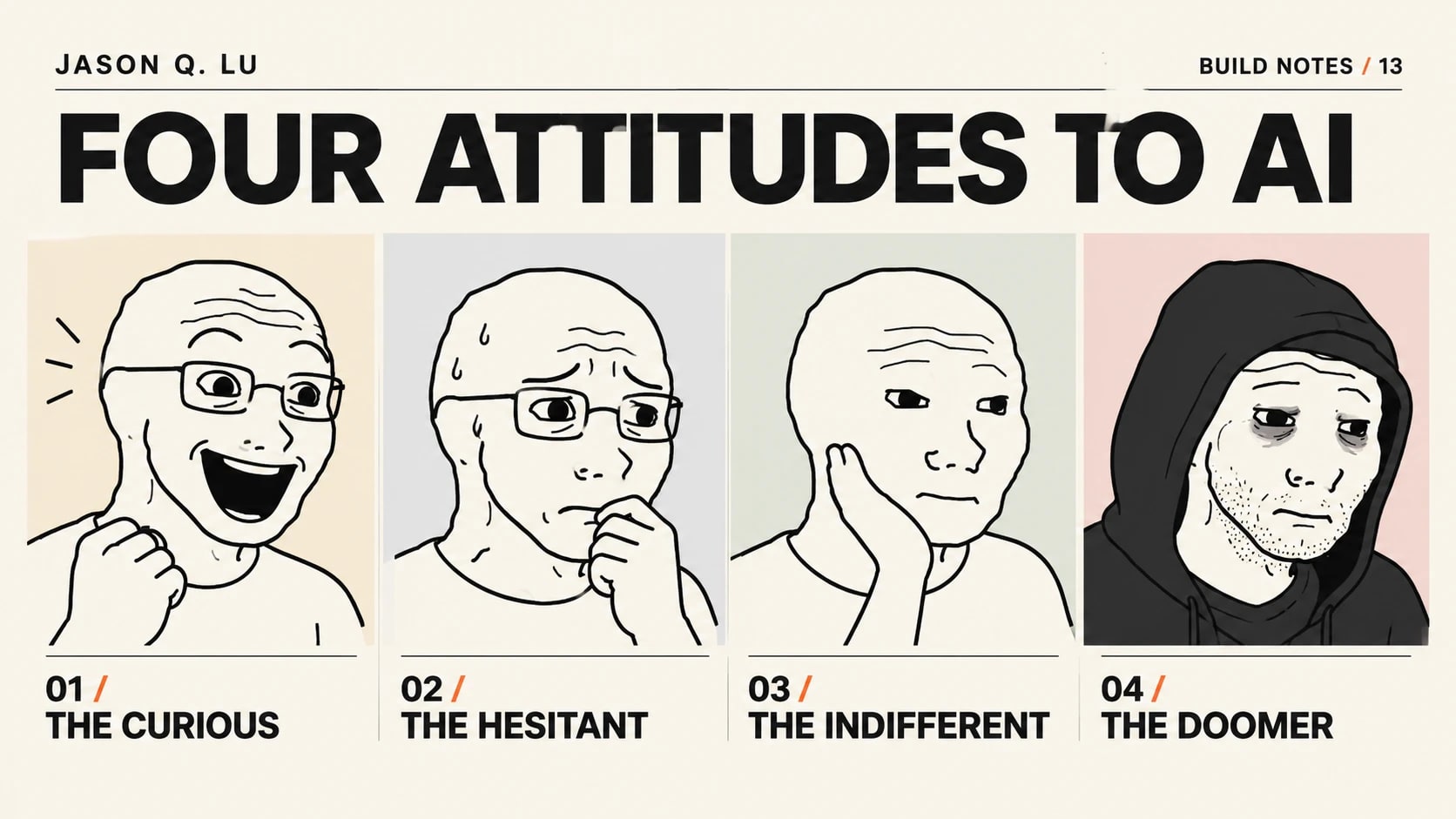
Change is coming to every team.
Change is coming to every team. Meet the four attitudes to AI in yours, then lead them with my version of Kotter's 8 steps, checked against the research.

Even Nvidia, the company selling the shovels in the AI gold rush, had a messy week. On 11 November its board accepted the resignation of Jensen Huang, its chief executive for 33 years, after he admitted to "serious mistakes" in his personal life. Its finance chief, Colette Kress, is now interim CEO while still doing the finance job. Six days later Huang said he'd be "honored" to come back. Somewhere at Nvidia, a change manager is redrawing the org chart in pencil.
Change management is more important than ever, and not only at the top.
In Build Notes 11 I said change management in the era of AI was next. Then the museum jumped the queue. This is me keeping my promise.
Why talk about change now?
This month Canva told its staff that 1,271 people, 22% of the company, are affected by a restructure. For some it means a new role or a move to one of its hubs. For others it means saying goodbye.
Qantas said about 850 roles will be affected over the coming years, as it moves some corporate work to Accenture, mostly in India, and steps up its investment in technology and AI.
They're not alone. In October NAB said it will cut up to 2,500 roles, about 6% of its workforce, mostly in corporate functions. In February WiseTech said it would cut about 2,000 roles over two years, nearly a third of its staff, as it builds AI into its software and its own work. The same month, Telstra's data and AI joint venture with Accenture said it would cut 209 roles and move some of the work to its team in India.
Not everyone buys the AI explanation. Unions now accuse big Australian companies of "AI washing": blaming AI for cuts that are really about moving work offshore. The Reserve Bank said this month that AI hasn't yet caused widespread job losses, though it sees early signs, like fewer job ads in the roles AI can do. For the people affected, the change is real either way.
We're entering a period of real volatility, and this will be a concern for many of you and your teams. The good news is that change can be managed well, and it starts with knowing who you're leading.
What do I think comes next?
This year has been really revealing, and I think it's only the beginning. Here's what I think is coming next. These are my predictions, not certainties.
More layoffs are coming. Canva and Qantas this month won't be the last. For your business: expect pressure to do more with fewer people, so plan for who that affects.
AI gets cheaper and easier to use. More businesses will get personalised systems, built for how they work. For your business: new roles appear to build and run them.
AI development slows down. In the US midterms on 3 November, Democrats took control of Congress. In local US votes, people backed limits on data centres, the huge buildings full of computers that AI runs on, by a wide margin. Expect more scrutiny of AI. For your business: plan around today's tools, and expect more rules on using them.
So change is coming to every team.
What are the four attitudes to AI?
From my own experience, speaking to people and working in corporate tech over the past few years, not everyone is on board with AI. These are the four attitudes I've seen.
The curious. The early adopters. They spend hours vibe coding (building quick apps just by describing them) fixes for past problems, only to realise most won't get used. What they need: a real problem to point that energy at.
The hesitant. Very apprehensive. They don't fully trust AI yet, and might not believe what it can do. Trust, and not understanding it, are the big barriers. What they need: proof, from someone they trust.
The indifferent. They don't really care. To them AI is just another hype cycle. They're already swamped. They just want the pay cheque. What they need: time, and one small win that saves them work.
The doomers. A small but vocal minority who loathe AI and won't use it for work. It might be fear, or not accepting that AI can do some of their work better. Or a childhood of anti tech movies. What they need: to be heard, not pushed.
Research points the same way. Leaders often underestimate how much their people already use AI. In McKinsey's late 2024 survey of US workers, bosses guessed that 4% of staff used it for 30% or more of their daily work. Staff said 13%. The same survey found 41% were more apprehensive and would need extra support. Those aren't my four, but the lesson matches: your curious are further along than you think.
So who do you think you are? Who are your peers? Spotting these four in a workforce lets you plan any change much better.
Where does Kotter's model come from?
John Kotter, of Harvard Business School, wrote about this in Harvard Business Review in 1995, in "Leading Change: Why Transformation Efforts Fail". He'd watched more than 100 companies try to remake themselves. Most landed in between, with "a distinct tilt toward the lower end". He named the eight mistakes behind that. His 1996 book, Leading Change, turned them into eight steps.
What has research found since? In 2012 Steven Appelbaum and colleagues checked 15 years of studies against each step, in the Journal of Management Development. Most steps had some support, but no study had tested the whole model. Its popularity, they said, comes from being practical more than from proof. They found nothing against it, and called it a good planning tool to use alongside others.
The steps also run in a straight line, and in my experience real change rarely does. Kotter's own firm now calls that version linear. His 2014 book, Accelerate, reworks it as 8 Accelerators.
About that 70% figure. You'll often hear that 70% of change programmes fail. In 2011 Mark Hughes looked for the evidence, in the Journal of Change Management, and found "no valid and reliable empirical evidence" for it. McKinsey's surveys find under a third of people say their company's transformation lifted performance and kept the gains. But that's people rating their own efforts. Plenty of change goes badly. Nobody can say reliably how much.
How do you lead the change?
Most of the work is people, not technology. BCG's 10-20-70 rule, from its January 2025 report on the AI impact gap, says the companies pulling ahead put 10% of their effort into algorithms and 20% into data and technology. The other 70% goes on people and how work gets done.
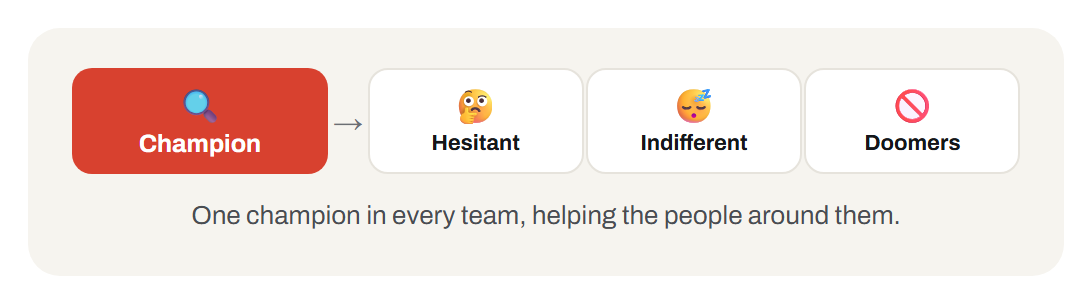
Here's my version of Kotter's 8 steps, a classic model for leading change, with the four in mind. The key is your champions: the curious people who help bring everyone else along.
| Step | What it looks like | Aimed at |
|---|---|---|
| 1. Create a sense of urgency | Show people why now. This month's news makes the case for you. | Everyone |
| 2. Build a coalition: enlist the curious as champions | Give your curious people time and a real problem, and make their job helping everyone else. | The curious |
| 3. Form groups | Small mixed teams, one workflow each, with a champion in every group. | Everyone |
| 4. Enlist the hesitant | Let them watch a champion they trust do their real job faster. | The hesitant |
| 5. Enable the indifferent and the doomers | Champions set the tools up for them. For the doomers, hear the objection out first. Some of it will be right. | The indifferent and the doomers |
| 6. Build a roadmap of short term wins | Wins you can show in weeks, like an hour saved on a weekly report. Share every one. | Everyone |
| 7. Sustain that level of acceleration | The first wins wear off. Keep your champions busy on the next one. | The curious |
| 8. Make the change formal, then scale it to other groups | Write it into roles and processes, then take the playbook, and a champion, to the next team. | Everyone |
My steps 3 to 6 differ from Kotter's own, because I've built them around the four attitudes. His are in the questions below.
Champions aren't just my idea. McKinsey calls them change agents. In its 2017 survey, people whose companies chose them reported success more often, and were twice as likely to say the culture had changed. Where line managers and frontline staff weren't brought in, only 3% said the change worked.
How do you prepare for change?
My advice: start with your people. Find your champions first, then plan the change around everyone else.
Then train them, and say plainly what's changing. In BCG's 2026 AI at Work survey of close to 12,000 people, 72% said the skills expected of them had shifted, but only 36% felt trained enough. Only a third of frontline staff found leaders' messages about AI clear.
Try this. List the people in your team and put each one under one of the four. The curious column is your list of champions. An empty column there is the first problem to solve.
Planning AI change in your team? Tell me which of the four you have most of.
Common questions
What are the four attitudes to AI in a team? In my experience there are four. The curious are already building with it. The hesitant don't trust it yet. The indifferent see another hype cycle. The doomers are a small, vocal group who won't use it for work.
What is a change champion? Someone already curious about AI whose job, during the change, is helping the people around them. I'd have one in every team.
What are Kotter's 8 steps? A classic model for leading change, from John Kotter's 1996 book Leading Change. Kotter Inc lists them today as: create a sense of urgency, build a guiding coalition, form a strategic vision, enlist a volunteer army, enable action by removing barriers, generate short-term wins, sustain acceleration, and institute change.
Do 70% of change programmes fail? No one has shown it. In 2011 Mark Hughes looked for the evidence behind the figure and found none that was reliable.
How many roles are Canva and Qantas changing? In November 2026 Canva said 1,271 people, 22% of the company, are affected by a restructure. Qantas said about 850 roles will be affected over the coming years.
What is AI washing? Blaming AI for job cuts that are mostly about cutting costs, such as moving work offshore. Australian unions used the term in November 2026 about Qantas and other big companies.
Sources and further reading
- AP, Ex-CEO Jensen Huang signals interest in returning to Nvidia after resigning amid scandal, as carried by PBS NewsHour, 17 November 2026.
- TechCrunch, The unfolding Jensen Huang scandal: a timeline, 13 November 2026.
- Canva, An important update on our team, November 2026.
- Qantas, Qantas Group fast-tracks technology and AI investment with new Accenture partnership, November 2026.
- HRD Australia, NAB to axe up to 2,500 roles in corporate overhaul, 20 October 2026.
- Reuters, AI disruption prompts Australia's WiseTech to cut a third of global workforce, as carried by The Star, 25 February 2026.
- HR Leader, Telstra, Accenture to cut 209 jobs for data and AI venture, 12 February 2026.
- Reuters, Australian companies face "AI washing" claims after wave of job cuts, offshoring, as carried by Insurance Journal, 12 November 2026.
- AP on the US midterms, 6 November 2026, as carried by NBC New York.
- John P. Kotter, Leading Change: Why Transformation Efforts Fail, Harvard Business Review, March to April 1995.
- John P. Kotter, Leading Change, Harvard Business School Press, 1996.
- Kotter Inc, The 8 Steps for Leading Change.
- Steven H. Appelbaum and others, Back to the future: revisiting Kotter's 1996 change model, Journal of Management Development 31(8), August 2012.
- Mark Hughes, Do 70 per cent of all organizational change initiatives really fail?, Journal of Change Management 11(4), December 2011.
- BCG, From Potential to Profit: Closing the AI Impact Gap, 15 January 2025.
- BCG, AI at Work: Why Strategy Matters More Than Tools, 3 June 2026.
- McKinsey, Superagency in the workplace: Empowering people to unlock AI's full potential, 28 January 2025.
- McKinsey, The people power of transformations, 10 February 2017, and Losing from day one: Why even successful transformations fall short, 7 December 2021, on the same page.
News as of 18 November 2026. The four attitudes are my own observation, not a study.
More on how I work: AI consulting in Sydney, and what an AI consultant costs in Australia.