I just had another aha moment.
Days of 3D modelling became a conversation with Fable 5.2
In one day of talking, Claude Fable 5.2 and Blender turned my 2011 architecture project into a gallery you can walk through. What it got wrong.

I know I promised to talk about change in my last Build Notes. But as you know, in the world of AI, nothing goes according to plan.
In the past week, Canva cut 1,271 roles, Qantas said about 850 jobs are moving offshore, Jensen Huang got caught focusing on the wrong model (Nvidia shares fell about 9.5% in two days), and then there's Fable 5.2.
If you work in an office, that's an unsettling week. The easy story is that AI did it. I'm not so sure. Canva's cuts came as its growth slowed. Qantas is moving work overseas, and offshoring is older than ChatGPT. And there's a new force on the way: a bill before the Senate could have any business with a website, AI chatbots included, write an online safety risk assessment every year.
So is it AI, or something else? That's the question I'll come back to, plan permitting.
As much as I want to talk about Jensen, mostly for the memes, I'd rather not offend anyone. So this week is about my aha moment: Fable 5.2.
What was the aha moment?
There's a scene in Blade Runner (1982) where Deckard sits at a machine and moves around inside a photograph just by talking to it, until he finds a detail hidden in a reflection. "Enhance 34 to 36."
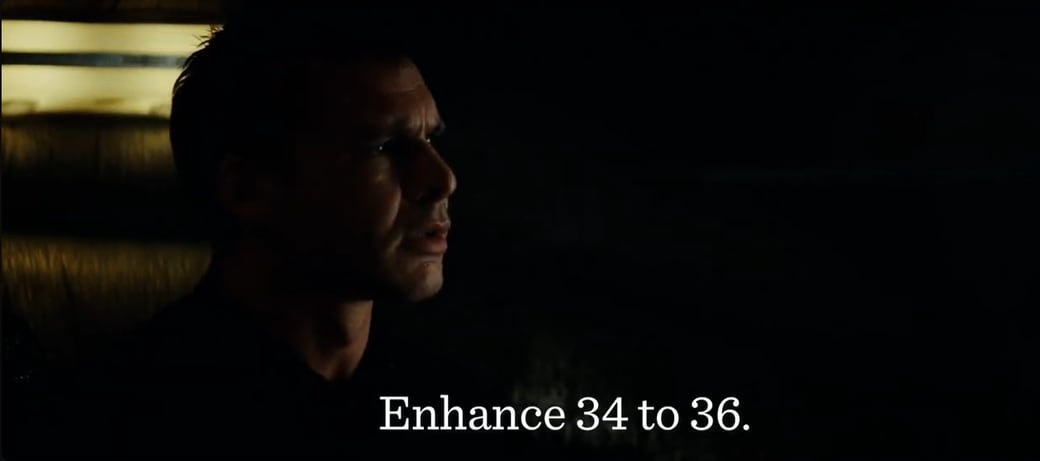
Watch the Esper scene on YouTube. Still from Blade Runner (Warner Bros, 1982).
The film is set in November 2019. We're seven years late and still have no flying cars, unless Musk has something to do with it. But the part where you talk to the machine has arrived.
My day one readers might remember this building from September, when GPT-6 Astra turned it into a 3D model. I designed it in 2011 for my final year architecture project, with tools that feel like the stone age now. Getting it from my head onto paper took about two weeks. Detailing it, adding materials and furniture, took days more, and that was before I'd even started on making it something you could move through online.
On Tuesday 10 November, I spent a day with Claude Fable 5.2 and Blender turning that building into a gallery you can walk through, with my writing on the walls. I didn't draw a single line. I just talked to it, like Deckard. It's now the front page of this site.
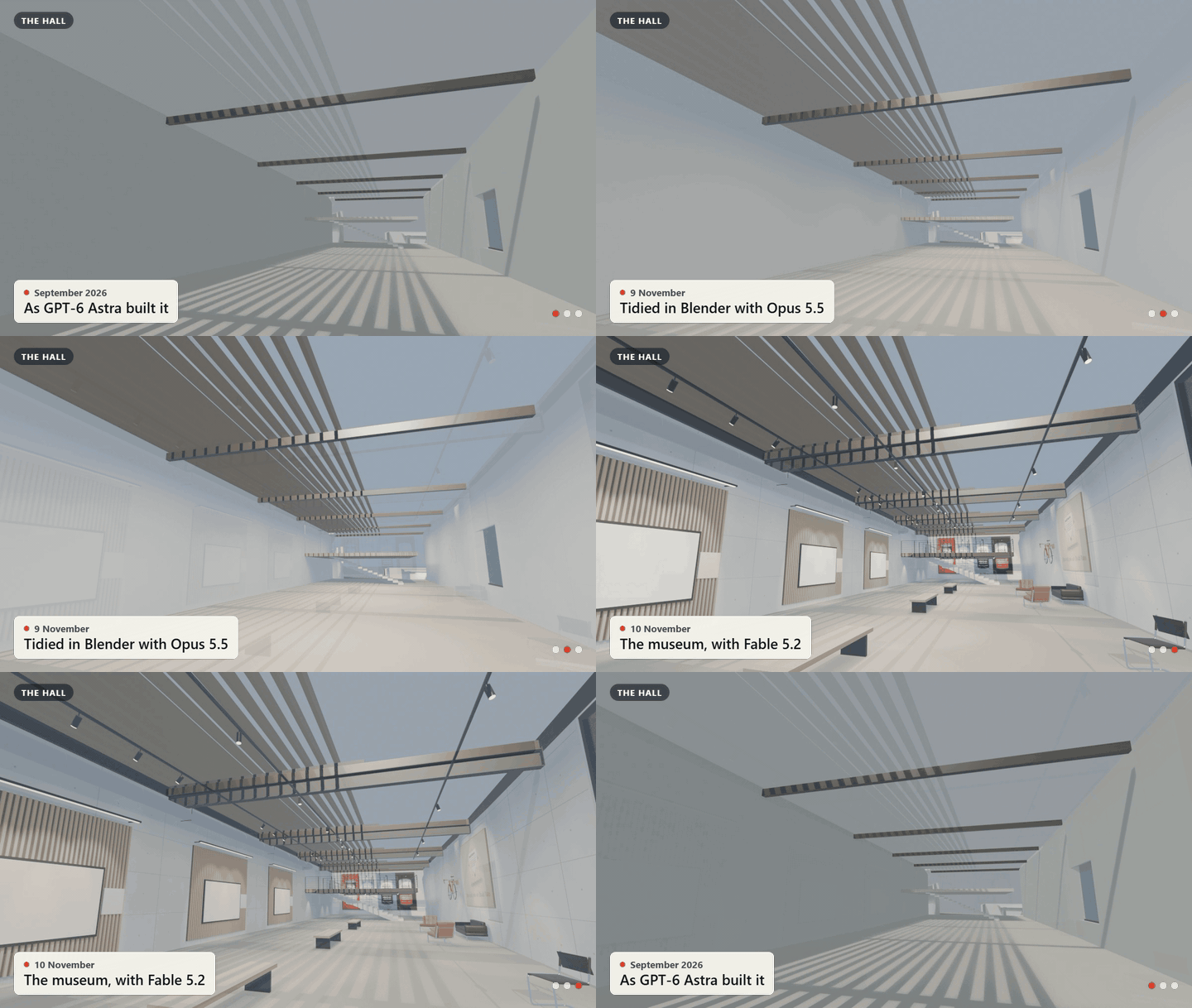
Astra's September model by day, then a pause at the entrance while the building moves through Opus 5.5's version at golden hour to the museum Fable 5.2 built, at night. It lands on the KOPA corner of the mezzanine. The entry and the hall follow further down, in three stages.
What used to take days?
The parts of the job that ate the time back then each became a line in a chat.
| 2011 | 10 November 2026 | |
|---|---|---|
| Camera angles | Set up one by one in the viewport | 20 new named views, rendered again after every change |
| Materials and light | Chosen and applied surface by surface | A sentence like "white concrete walls". 21 materials became 73, and 70 lights went in |
| Objects | Modelled and placed by hand | A note. 393 new objects, including sofas Fable modelled itself |
| Getting it online | A whole job after the modelling | Live on this site at 5:24pm the same day |
Why turn a building into a home page?
My old home page was a menu: services, work, about, and a newsletter box near the bottom. People looked around and left.
I wanted one page that leads with the writing and asks for one thing, which is to subscribe. The building is the hook. The articles hang on its walls. Halfway through the day I reminded Fable, and myself, what the point was: the writing. The building is how you get to it.
Where did the building come from?
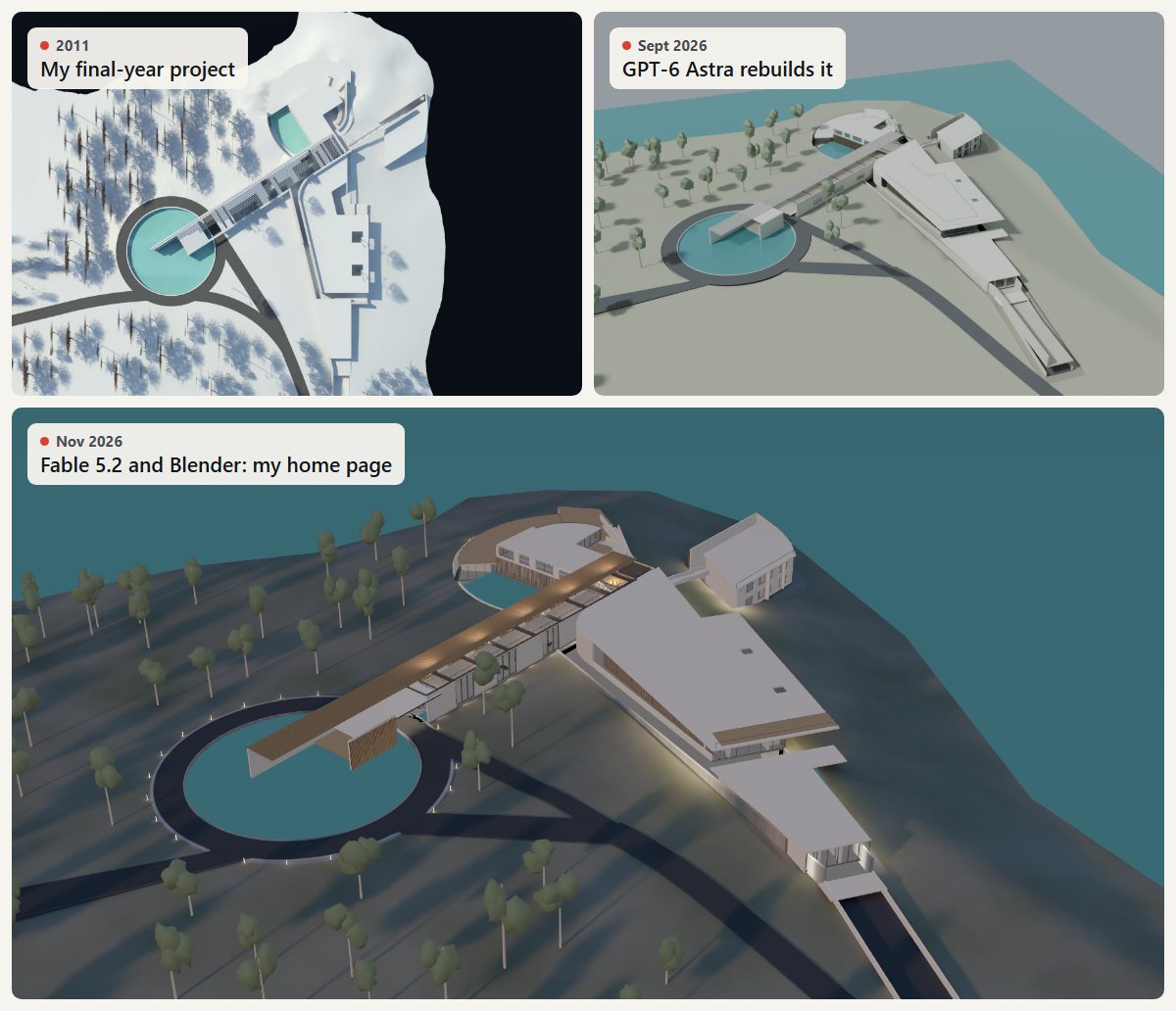
It has had three lives. In 2011 it was drawings and renders. In September 2026, GPT-6 Astra rebuilt it from three plans and three sections, as a model of 2,037 objects. On 9 November I used Claude Opus 5.5 to tidy that model in Blender and light it at dusk.
On the morning of the 10th I switched to Fable 5.2 and asked for the inside. By 5pm the model had grown from 2,142 objects to 2,535.
How did Fable 5.2 work with Blender?
Through the Blender MCP, a connector that lets Claude send instructions straight into Blender and look at the result. It's like a builder on site who sends you photos from the same spots after every change.
My first instruction set the role: act as an experienced interior designer, do your research online, find models that can be downloaded, and improve the building as you go.
After that it was a loop. Fable changed the model and rendered the same named views: the gallery from the stairs, the ceiling, the drop-off. I replied with numbered notes. By late morning it had been round that loop five times.
It also sent three helpers off on research: what material I had from past projects, which furniture models were free to use, and how to model things I own.
What were the steps?
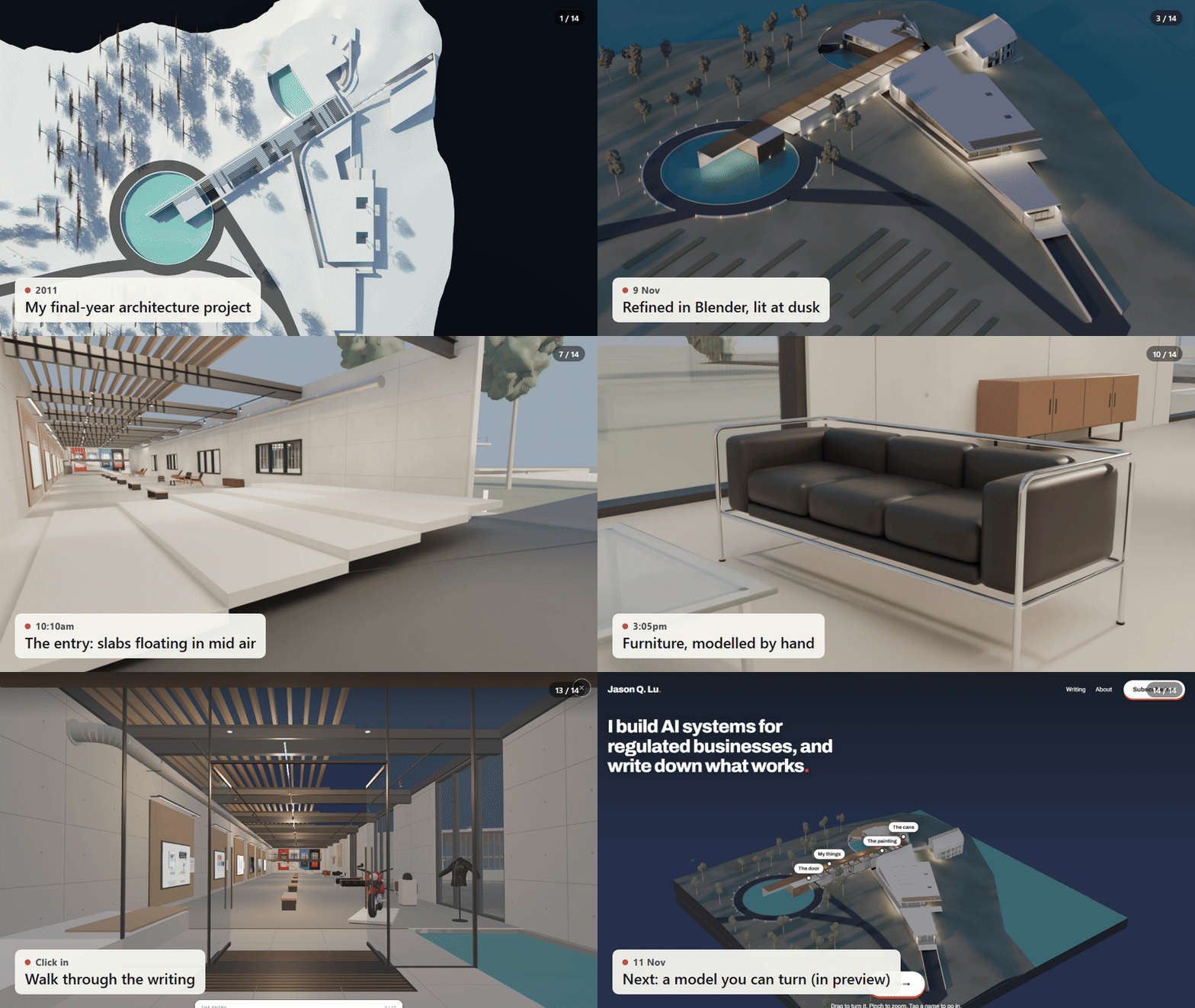
- 8:10am. Turn the model into a museum. Start with a bird's-eye view and fly in through the entrance.
- 9:39am. An industrial ceiling with steel beams and spotlights. White concrete walls. Thicker stairs, railings on the mezzanine, and a big painting of cans at the end of the hall.
- 10:01am. Floor-to-ceiling glass, black sofas in the style of Le Corbusier's LC2, and a proper entry. The driveway ended at a wall, and slabs were floating at the door.
- 11:00am. Details. The duct runs into the wall, the ground is flush, and the walls meet the ceiling properly.
- 12:10pm. I walked it myself and sent seven notes with screenshots. Most were clashes. One was a new painting: Ceci n'est pas un Build Notes.
- 1:29pm. The building becomes the full-screen hero, the first thing you see.
- 2:10pm. The articles show live on the gallery walls. You scroll them where they hang, and click through for the full page.
- 3:13pm. Things I own, as exhibits. I only had photos, so Fable modelled them.
- 5:24pm. Live, replacing the old site. Fixes for phones went live at 9:46pm.
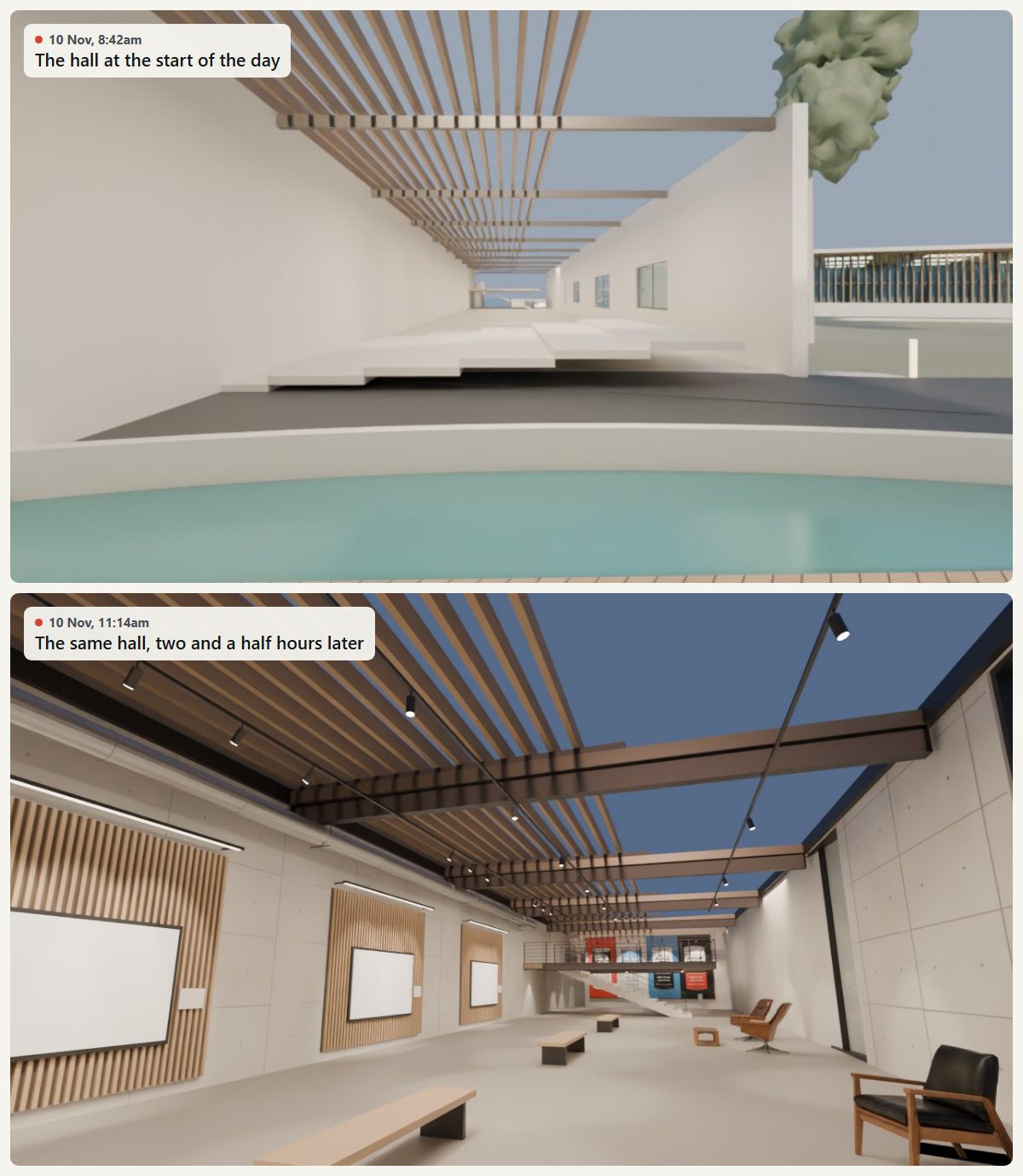
What did Fable get wrong?
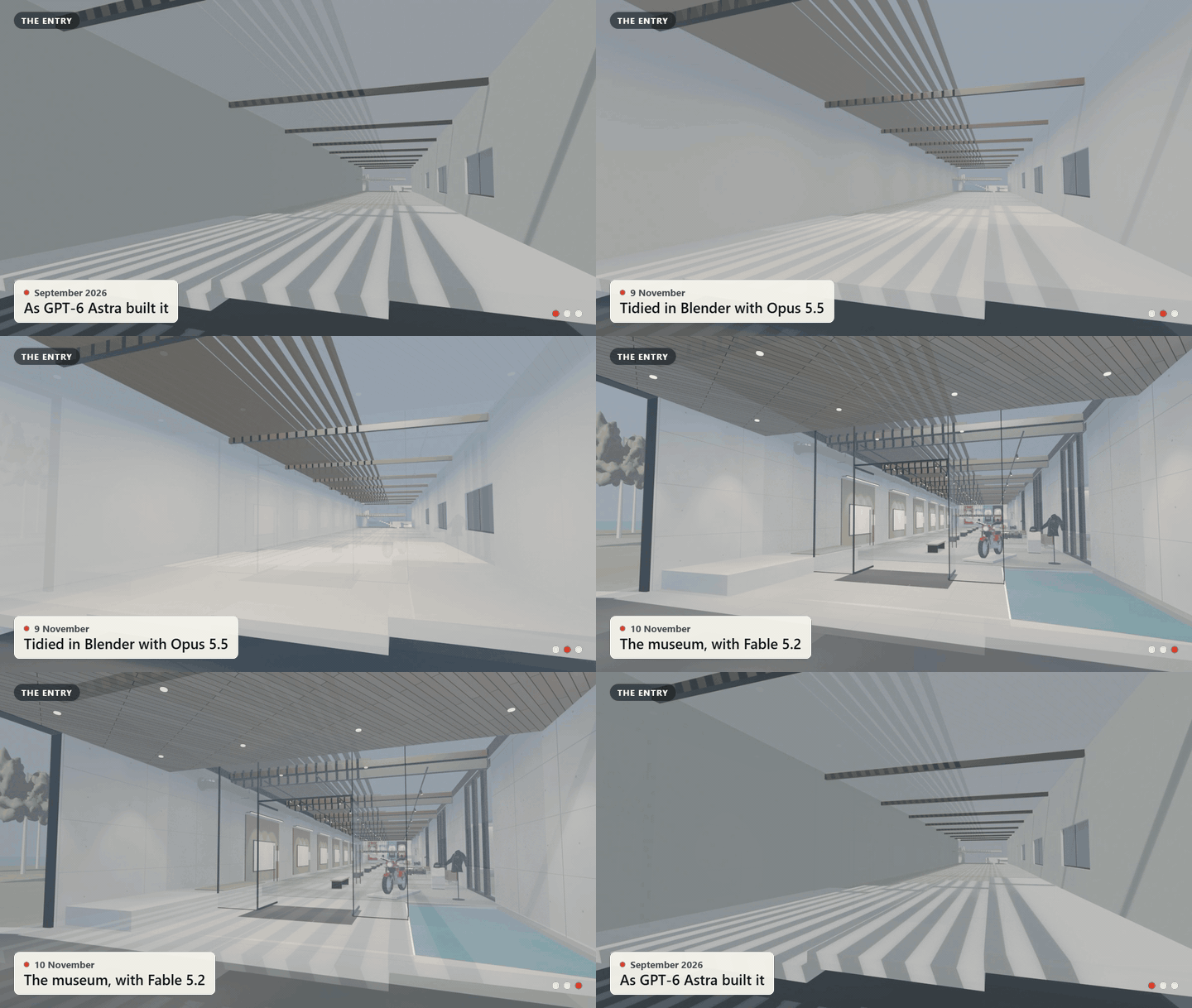
Fable was good at the big moves. Ask for an industrial ceiling and you get steel beams and spotlights. Where it struggled was where things meet.
| What it got wrong | |
|---|---|
| Clashes | A wall running over the kerb, a window cutting into a wall, a slab poking through under a chair. |
| Loose ends | A duct stopping short of the wall, slabs floating at the entry, a driveway that ended at a wall. |
| Blanks | An empty card next to every article on the wall. |
| Phones | It went live at 5:24pm. By 9pm I couldn't find the button to go in on my phone. Fixed by 9:46pm. |
I found most of these by walking through it myself, the way you'd walk a site before handover. AI does the big moves. You still have to walk the site.
The furniture was the surprise. When I asked for the LC2-style sofas, Fable went looking and came back with a problem. The accurate free models are copies of designs that are still protected in several countries. So I told it to model them by hand. It built a matching set to real dimensions, named after no product, plus a road bicycle and my AGSM cap.
My old Royal Enfield and a leather jacket are built on free models by other people, changed for the gallery, and credited at the foot of the home page.
What did one day of conversation make?
I counted from the model files themselves: the one I started the day with, and the one saved at 5pm.
| Morning of 10 November | 5pm, 10 November | |
|---|---|---|
| Objects in the model | 2,142 | 2,535 |
| Materials | 21 | 73 |
| Lights | 87 | 157 |
| Named camera views | 12 | 32 |
| Polygons (the faces the surfaces are built from) | 177,279 | 427,173 |
My side of it was about 1,200 words across 28 messages. Fable's side was about 3,200 lines of Blender script, kept in this site's code, plus 71 web searches and page reads on furniture, licences and how to model things I own. It also saved 35 renders along the way.
How many tokens did it use?
| Fable 5.2, 10 November | Opus 5.5, 9 and 11 November | |
|---|---|---|
| Messages from me | 28 | 20 |
| Calls to the model | 690 | 411 |
| What it wrote (output tokens) | 1.19 million | 0.62 million |
| Conversation re-read from the cache | 381 million | 99 million |
| Written to the cache | 5.1 million | 2.4 million |
| Cost at list prices | about US$199 | about US$51 |
A token is a piece of a word. Most of that count is re-reading: at every step the model reads the whole conversation again. A cache makes that cheap. On Fable 5.2 a cached read costs 2.5% of a normal one.
All in, about US$250 at Anthropic's list prices for three days of work, and US$199 of it was the day with Fable. That's about US$7 for each of my 28 messages. Some of them were just the word "done", which makes it the most expensive word I've ever typed. The Opus column also covers writing the brief for the new home page on the 9th.
What does it mean?
The work moved again. Making the model used to be a big part of the job. On 10 November the making was the cheap part, and the amendments became the time consuming job.
My architecture training did a lot of the work. I knew what a porte cochère should look like, and I could see when a wall hit a kerb.
That's why I see AI as an amplifier. It turns up whatever you bring to it. The more you know, the more you get out of it.
Watch that Blade Runner scene again. The clever part is Deckard knowing where to look.
What does it open up?
Back in Build Notes 04, I wrote that every frontier model launches as an opportunity model and ends up an efficiency model. An efficiency model does a job you already do, faster or cheaper. An opportunity model does a job that wasn't possible before.
This was an opportunity model at work. Nobody was ever going to pay a studio to turn a student project into a home page. The job wasn't on the list, and now it's done.
For a business, that changes what's worth trying. A space people can walk through used to take a studio and months. Now it can take a day of conversation. A developer could open an apartment before it's built. A clinic could let a nervous patient walk in before their first visit.
I'm treating my building the same way. I'll keep opening new sections and trying new uses. I want it to become a place people gather, maybe with a room for video calls, or a gallery for video.
None of that was impossible before. The cost and the people it took kept experiences like this rare. Now one person can open a new section in a day, by talking to an AI. In a year it'll be an efficiency job. Right now, it's an opportunity.
The first new section is already open. On 11 November, back on Opus 5.5, I asked for a maquette: a small model of the building that you can turn, zoom and tap to go in. It's the first thing you see on the home page now, and the newest writing always hangs on the first screen inside.
What does it mean for you?
1. AI is an amplifier. The making is getting cheaper in every field. What you know decides what you get out of it.
2. Experiment, then make it a skill. Try new jobs on an opportunity model, and turn what works into skills for an efficiency model. This month, that means Fable 5.2 to try the job that wasn't on the list. Then Opus 5.5, at half the price, to repeat it from a skill: a saved set of instructions it follows every time.
Common questions
What is Claude Fable 5.2? Anthropic's most capable widely released model as of November 2026, built for long, multi-step work. Its list price is US$8 per million tokens in and US$40 per million tokens out.
What is the Blender MCP? A connector that lets Claude send instructions to Blender, the free 3D software, and read back what happened, including renders it can look at. Claude writes small scripts and Blender runs them.
How much did it cost to build the 3D home page? About US$250 at Anthropic's list prices across three days, US$199 of it on the day with Fable 5.2. Most of the tokens were the model re-reading the conversation from a cache.
Do you need to know Blender to do this? Not to drive it. I gave notes and Fable did the modelling. What helped was knowing what a good building looks like and being able to say exactly what was wrong.
The week's news: TechCrunch on Canva, ABC on Qantas, The Globe and Mail on Nvidia and SmartCompany on the online safety bill, which was before the Senate, not yet law, as of 12 November 2026. Token counts are from my Claude Code session logs, 9 to 11 November 2026, priced at Anthropic's list prices in November 2026. It is what the tokens would cost at those prices. The motorcycle is built on Clasic Motorcycle Model 3D by Diego Lengyel Herrera, and the jacket on Biker Jacket by BriannaDavis, both under CC BY 4.0 and changed for the gallery.
More on how I work: AI consulting in Sydney, and what an AI consultant costs in Australia.