How I doubled my newsletter with AI, and your vote on engineers
AI helped me send 292 LinkedIn messages and 63 people joined, about 1 in 5. The lift came from the human side. Plus the vote on whether engineers are redundant.
In two weeks of September and October 2026, my newsletter went from 67 subscribers to about 130. I used AI to message 292 people on LinkedIn, and 63 joined, about 1 in 5. The AI did the fiddly part. The biggest lift came from the human side.
This is the ending of AI helped me message 239 people, which told how the system was built and gave the first numbers.
How did I grow my newsletter with AI?
A confession: I hate outreach. Working out what to say to hundreds of people, then copying it into LinkedIn one at a time, is the job I put off the longest.
But I had a real business problem: I wanted more people on my newsletter. So I built a system to take the friction out.
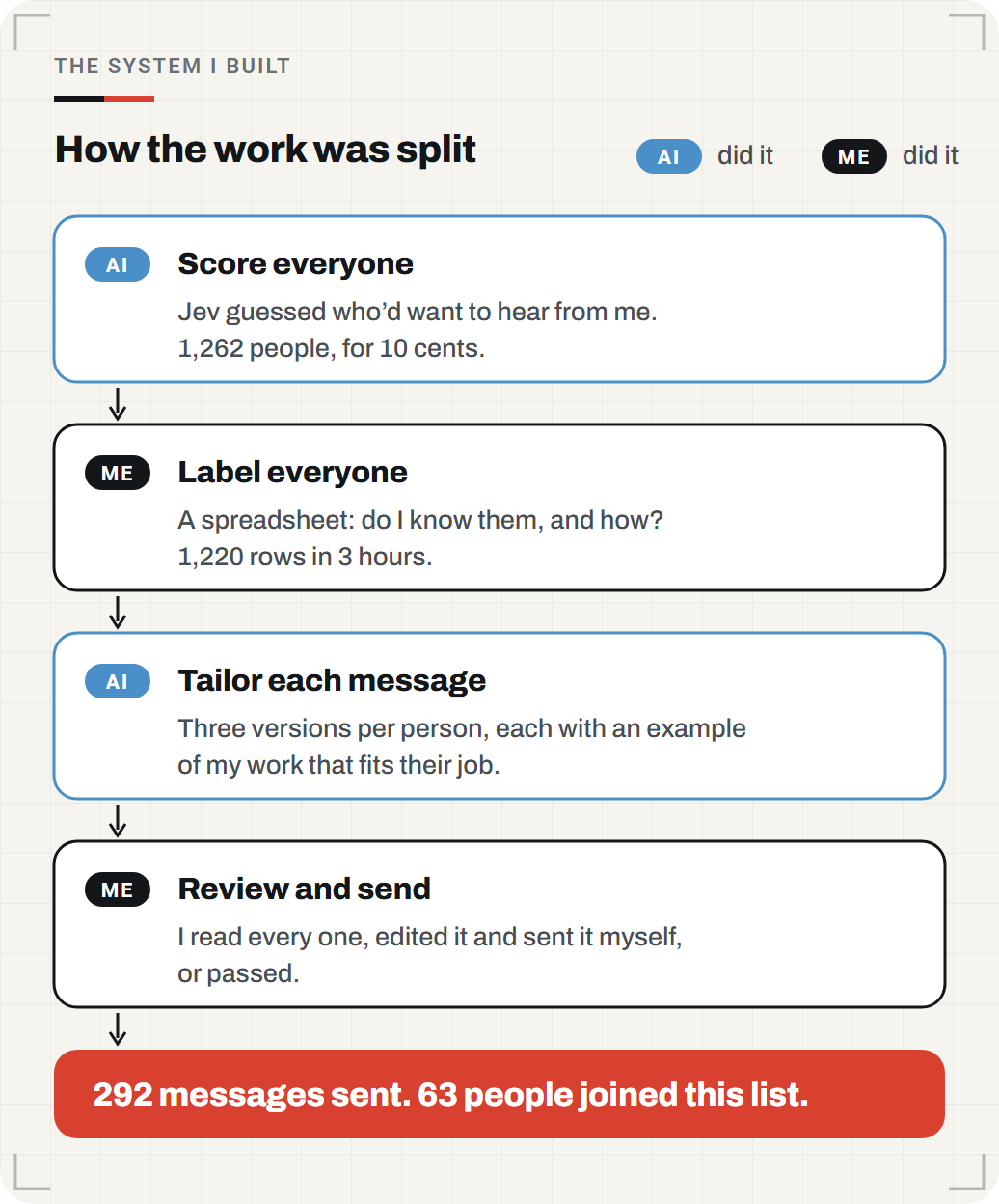
The tool did the fiddly part. It drafted the message, matched an example of my work to the person, and opened LinkedIn with the message already filled in. All I had to do was press send. For someone who hates outreach, that's about the right amount of effort.
Was it all AI?
No, and that's the part I find most interesting. Before anything went out, I spent 3 hours going through 1,220 people in a spreadsheet: who I actually wanted to talk to, and how I knew them. I passed on plenty.
So if you got a message from me, I genuinely wanted to hear from you. It wasn't a robot deciding.
I set the goal and brought the context. The AI removed the friction. To me, that mix of person and AI is a far better use case than handing the whole thing to a bot.
Did the AI outreach work?
| Who I messaged | Joined the newsletter |
|---|---|
| Everyone, 292 people | 63, about 1 in 5 |
| People who know me | 34% |
| People I'd never met | 14% |
For context, published figures for LinkedIn messages to people you're already connected to usually sit between 5% and 15%, and that counts any reply at all. Mine counts people who actually handed over their email.
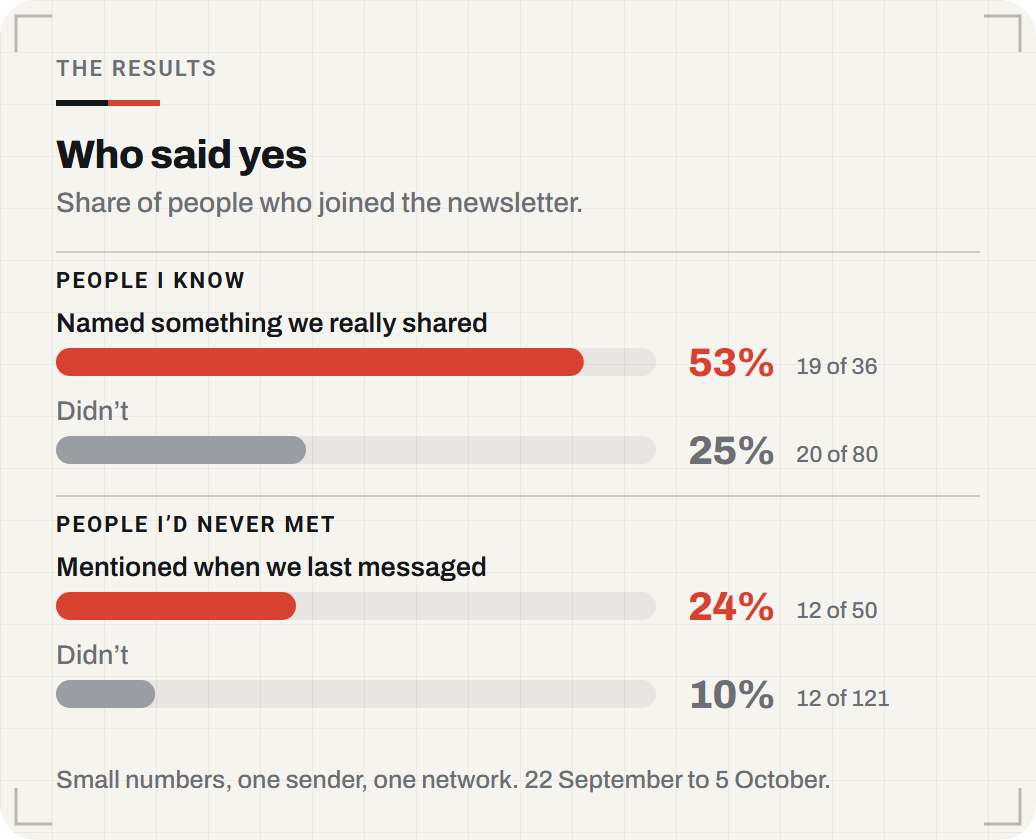
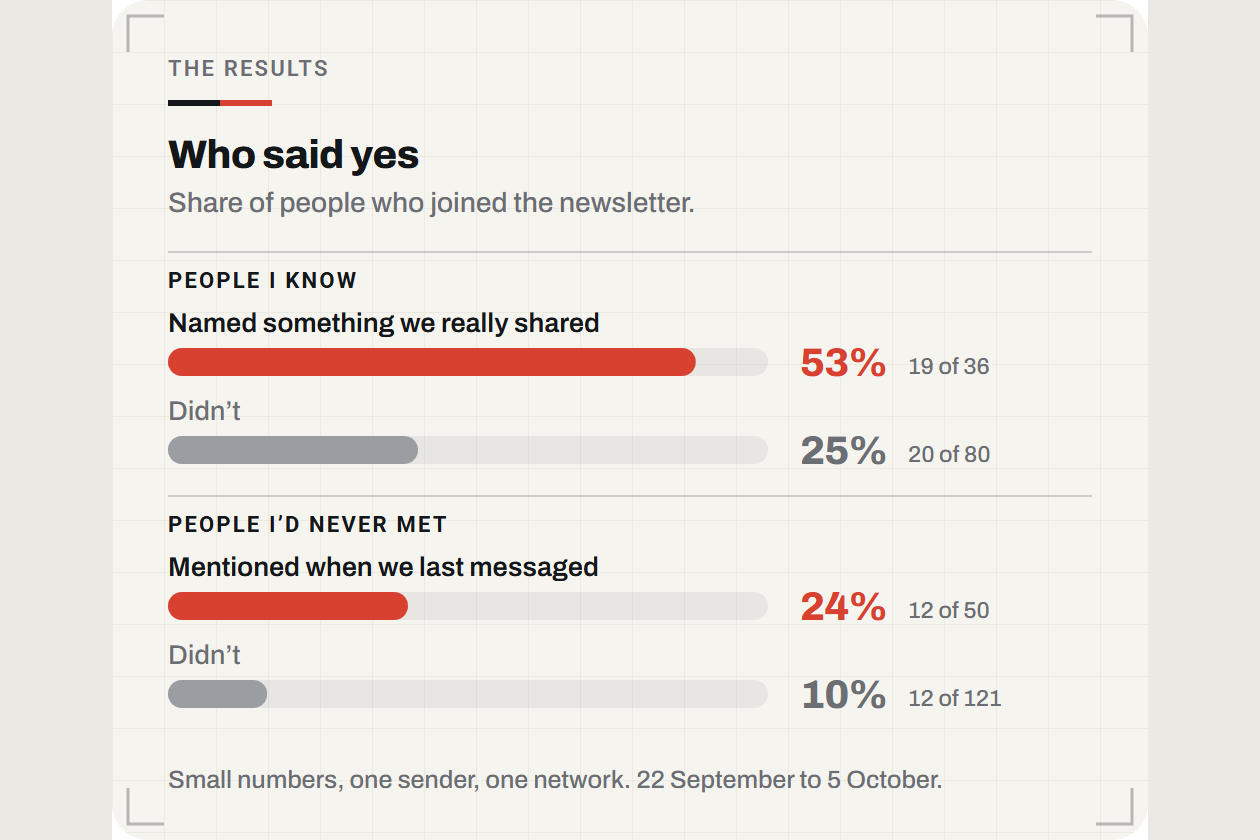
The biggest lift came from the human side. When a message mentioned something we'd really shared, people were about twice as likely to say yes. Those lines came from my own notes, not the AI.
Where did the AI fall short?
The AI had a blind spot. A few days in, someone asked whether they were talking to me or my AI avatar. Fair question. I cut every message down to a few short lines.
Jev, the AI scoring them, rated the short versions exactly the same as the long ones. It couldn't tell a message sounded like a bot. People could, immediately.
What did the outreach tool look like?
One card per person, three versions of the message, an example of my work matched to them, and one tap to open it in LinkedIn and press send. These aren't real people.
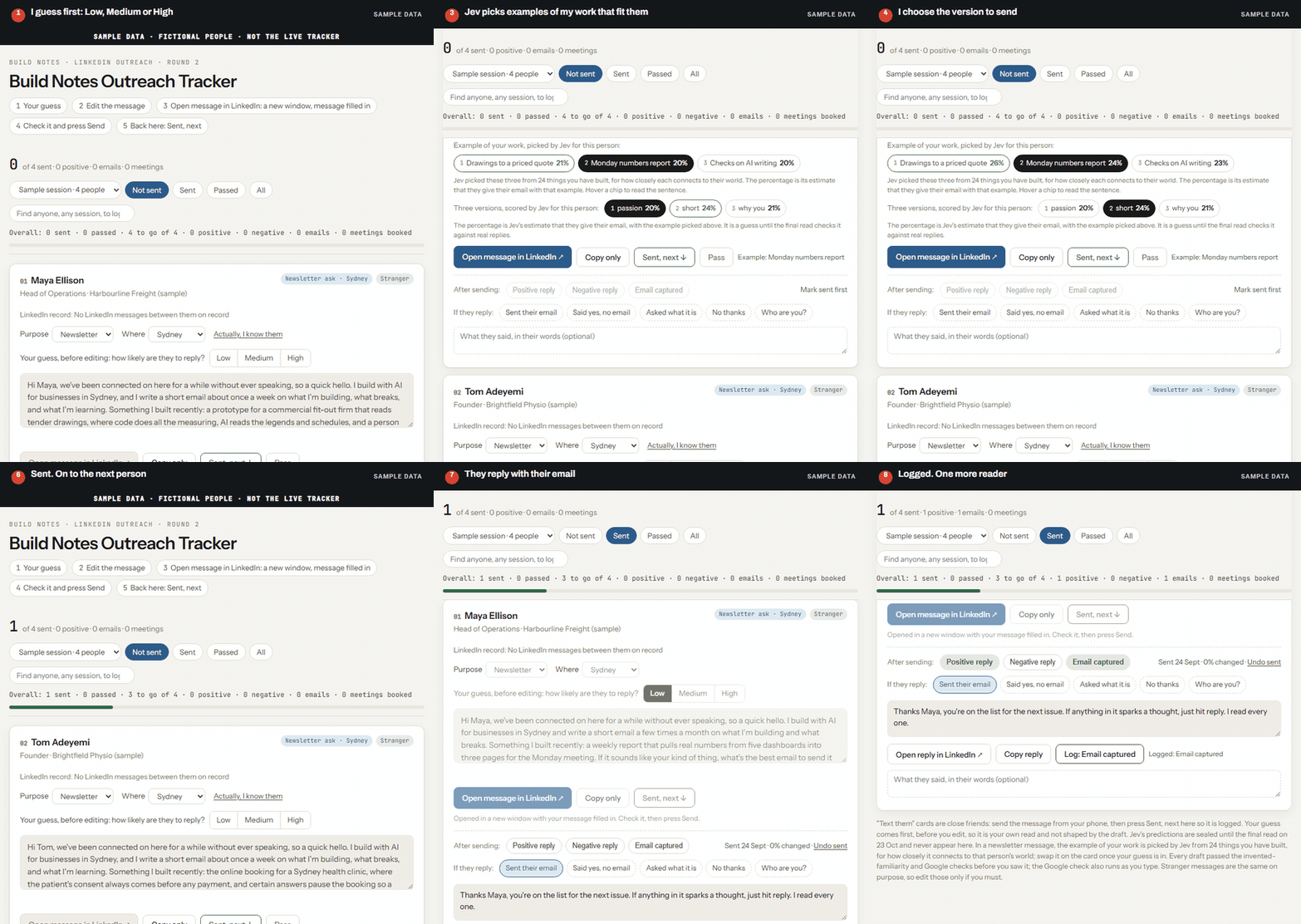
Sample data: made-up people, the real tool.
Are software engineers becoming redundant?
The issue before this one made a big call: engineers who only care about writing code are about to go the way of architects. Then I asked readers what they thought.
| Vote | Count |
|---|---|
| Yes | 7 |
| No | 16 |
| Votes | 23 |
Surprisingly, a lot of the yes votes came from engineers.
Is software dead?
My take: software isn't dead, it's changing. You can work out at home for free, so why are there gyms? Free workout videos didn't kill personal trainers either. People pay for someone who knows what to do for them.
It's the same with software. Writing code is getting cheap. Knowing what to build isn't. The part that's only typing goes, and what you know becomes the value.
My bet is that apps on their own won't be worth what they were in the era of software subscriptions. Instead, far more products will come from independent developers and indie game makers. In that sense, software is about to flourish.
Custom software, built for one business or one person, will be what people ask for. It's one reason so many of my friends are leaving their jobs to build their own thing. If you can think it, you can now build it.
Can I get an outreach system like this for my business?
Yes. I set them up built around your contacts, your notes and your voice. The AI does the volume. You still read and send every message yourself, so nothing goes out that you haven't approved. Book 25 minutes to talk it through.
Common questions
What is a good LinkedIn message response rate? Published figures for messages to existing connections usually sit between 5% and 15%, counting any reply. Mine was 63 of 292 joining the newsletter, about 1 in 5, counting only people who gave their email.
Did AI write and send the LinkedIn messages? AI scored the list and drafted three versions of each message. I labelled all 1,220 people by hand, read and edited every message, and sent each one myself.
What made people say yes to an outreach message? Naming something we had really shared. People I know joined at 53% when the message did that and 25% when it didn't, and those lines came from my own notes, not the AI.
Can AI tell when a message sounds like a bot? Not in this test. Jev rated short and long versions of a message the same, while a reader asked within days whether they were talking to an AI avatar.
Numbers to 5 October 2026: small numbers, one sender, one network. LinkedIn benchmarks from Overloop, Expandi and Valley, 2026, mostly from companies that sell outreach tools.
This started life as Build Notes Nº 09, in October 2026.
Want this mapped for your business? Book a 30-minute call.
More on how I work: AI consulting in Sydney, and what an AI consultant costs in Australia.
Get the next one
Subscribe and get the free course, Build Your First AI Operating System. Then a few emails a month on what I build, including what didn't work. See the course