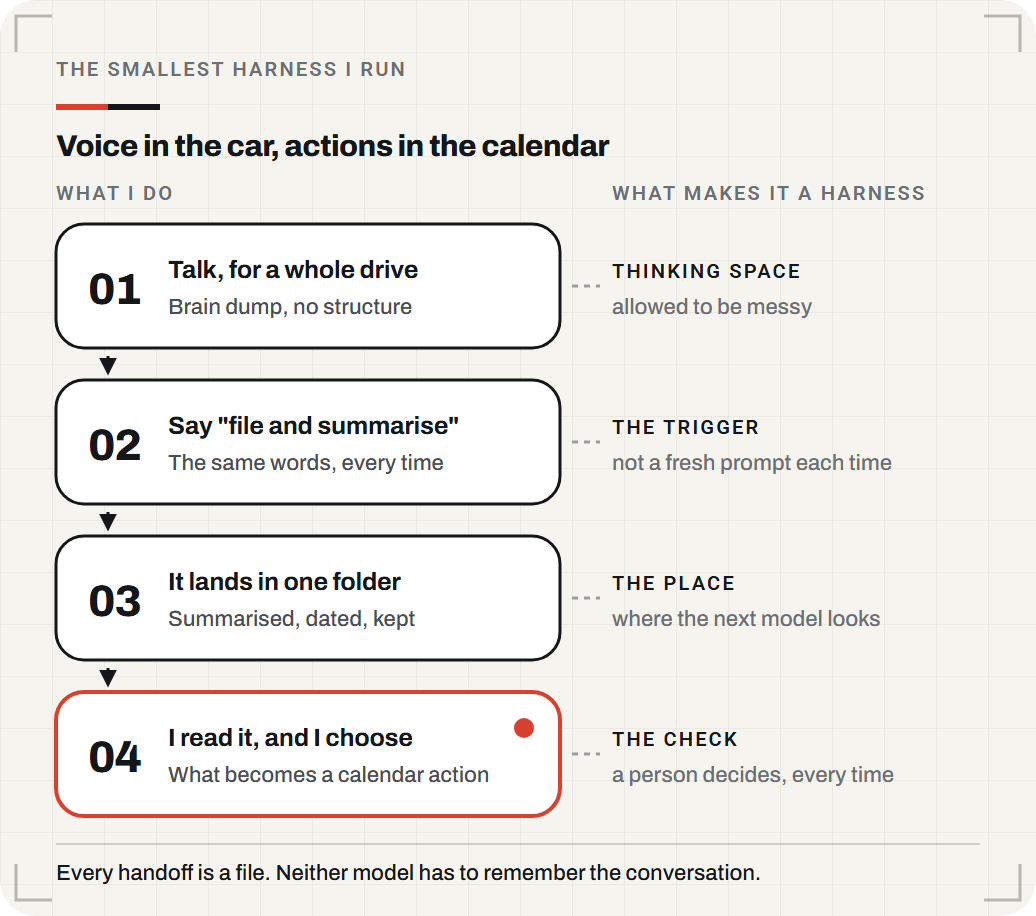
Voice in the car, actions in the calendar
Four steps and no software: a phrase I say every time, one folder, a file handed from one model to another, and me deciding what reaches the calendar.

Garry Tan, who runs Y Combinator, wrote one line about where software companies end up. Either you become a system of record, a place where data sits, or you live long enough to become a domain-specific harness.
I have used that word here before, so quickly: the model is the engine, and the harness is everything wrapped around it. The rules it follows, the place it reads from, the check before anything counts.
His point was about startups. Mine is much smaller. I run a harness that is four steps and no software, and it turns a drive into things in my calendar.
What are the four steps?
| # | What I do | What makes it a harness |
|---|---|---|
| 01 | Talk to ChatGPT voice in the car. A brain dump: things I remembered, things I am chewing on, nothing structured | Thinking space, allowed to be messy |
| 02 | Say the same thing every time: file and summarise | The trigger, not a fresh prompt each time |
| 03 | It writes one summarised note, dated, into one folder in my system | The place, where the next model looks |
| 04 | At my desk I open Claude, it reads that note, and we work out what turns into an action in my calendar | The check, a person decides every time |
Two different models, no shared memory, and no integration between them.
What actually makes that a harness?
Four things, and only one of them is the AI.
- A fixed trigger. "File and summarise" never changes. I am not writing a fresh prompt each time, so the note comes back in the same shape every time, which is the only reason it is usable later.
- One place. One folder, always. Claude knows where to look without me explaining. If those notes landed somewhere different each time there would be nothing to point at.
- The handoff is a file, not a conversation. ChatGPT does not talk to Claude. It writes a file and Claude reads it. Neither has to remember a long chat, and I can swap either model tomorrow without touching the rest.
- A check. Nothing reaches my calendar because a model suggested it. I read the note and I choose. That is not a formality: most of what I say in the car does not survive it.
Why is the wrapper the part that matters?
Tan's argument is that the durable advantage is not the model, it is the wrapper built by people who understand the work. The same thing is visible at this very small scale.
Every useful piece of that loop came from knowing my own work: what I tend to chew on while driving, where I go looking for things afterwards, and what actually deserves calendar time. The model is interchangeable. The four steps are mine.
Nobody could have sold me this. It is too specific to be a product, and it took about a week of noticing to arrive at.
What should you try this week?
Pick something you already talk about out loud and then do nothing with. The drive home, the walk between meetings, the ten minutes after a client call.
Give it three things:
- A fixed phrase you say every time.
- One place for it to land.
- A moment later in the week where you read it and choose.
That is a harness. It is not software, and you could have it running tomorrow.
One honest note. I counted my own folder while writing this: eleven notes in eighteen days, and I have never once gone back and read them as an archive. All of the value is in step four, on the day. If you are starting a capture habit because you think it will become a library, watch what you actually reopen.
Common questions
What is an AI harness? Everything wrapped around the model: the trigger you always use, the place the output lands, and the check before anything counts. The model is the engine; the harness is what makes it usable twice.
Do I need software to build one? No. Mine is a phrase I say, a folder, and a moment in the week where I read what came back. Two models that do not talk to each other, and no integration between them.
Why hand over a file instead of connecting the two models? A file means neither model has to remember a conversation, and either one can be swapped without touching the rest. It is the cheapest possible interface.
Does the AI put things in my calendar? No. Nothing reaches the calendar because a model suggested it. I read the note and decide, and most of what I said in the car does not survive that.
Want to build one for your business rather than your commute? The free course walks through the first version in about twenty minutes, or tell me what's stuck and I will tell you what I would look at first.