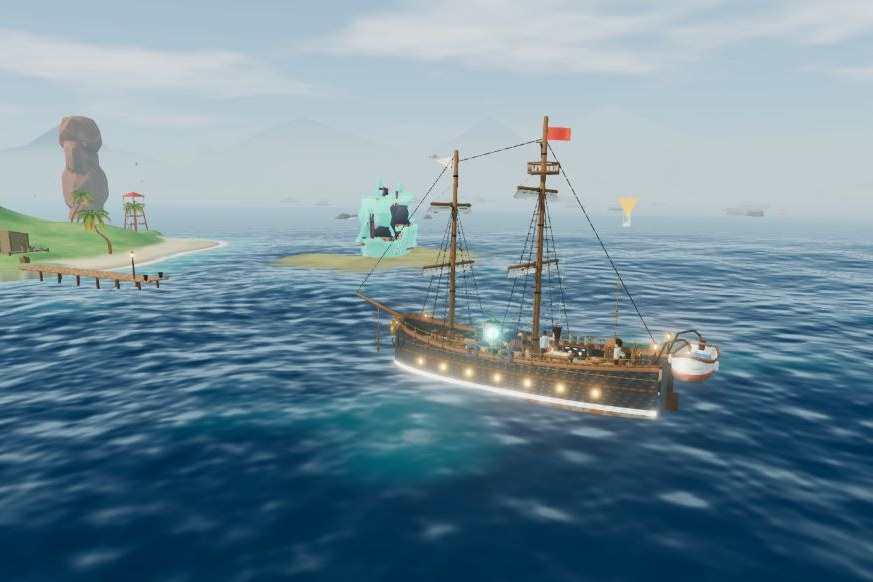
I built a game to tackle a real business problem: training.
A year-old bet about AI models, and the game I built to test it: five versions, four models, about $456, and what it taught me about learning games.

About a year ago, a friend and I wanted to see whether AI could build games that teach complex topics. In September 2026 I built one: The Living Ship, a free browser game that teaches what an AI OS is. Five versions, four AI models, about $456 at list price.
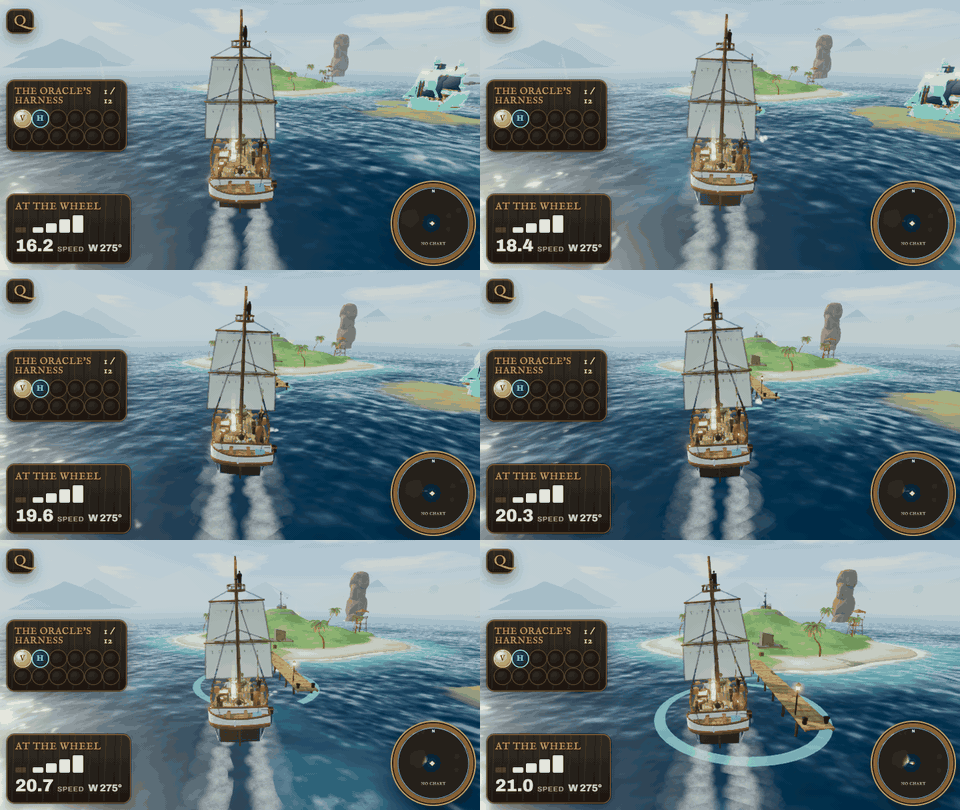
Play the game free. It runs in your browser, with no account needed. A laptop and sound on is best.
Why build a game to tackle training?
If you've ever joined a big company, you know the onboarding and training manuals. They're necessary and dull, and they usually end up as a checkbox you rush through without taking anything in. We wanted to fix that.
We also had a bet. A business built on one AI model will eventually fail, because the models keep changing. The ones that build alongside each new model will last. Games suit that bet. Think of graphics cards: every new release, games look better and new versions ship, while the core idea of the game stays the same.
I'm not a game developer, but I've been a gamer for a very long time, much to my parents' disappointment.
The game teaches what an AI OS is: the set-up around an AI that decides what it can read, what it remembers, what it's allowed to do and who checks its work. Think of the AI as a capable new hire, and the AI OS as their handbook and sign-off rules. I fed the AI my AI OS course and asked it to turn it into a game. It's an experiment, live and free.
How much did one month of new models change?
I started building the game in early September 2026. The same idea went from a pixel game to an open-world explorer when a new model, Opus 5.5, arrived. The first week of the build, against 26 to 29 September:
| What I counted | First week | 26 to 29 Sep | Change |
|---|---|---|---|
| Saved checkpoints of the work | 20 | 96 | 5x |
| Lines of code | about 9,200 | about 18,500 | 2x |
| Automatic checks for what breaks | 33 | 286 | 9x |
It felt like ten times to me. The counts say less, and they miss the kind of work: 3D models, a ship that moves on water, voices and music, none of which I can make myself. Not a clean test, just one builder's experience.
Training isn't the only use. When I was at Are Media, an Australian media company, keeping readers on the site was a challenge. My gut feeling is that puzzles and games, personalised to each reader and generated on the spot, could keep people on the page longer. The models can now build and test an idea like that in an hour instead of a week.
How did the game change from model to model?
The core idea never changed: the AI is a brain, and the harness is its body (the tools and rules that let it act). What changed was the model building the game, and each new one took it further.
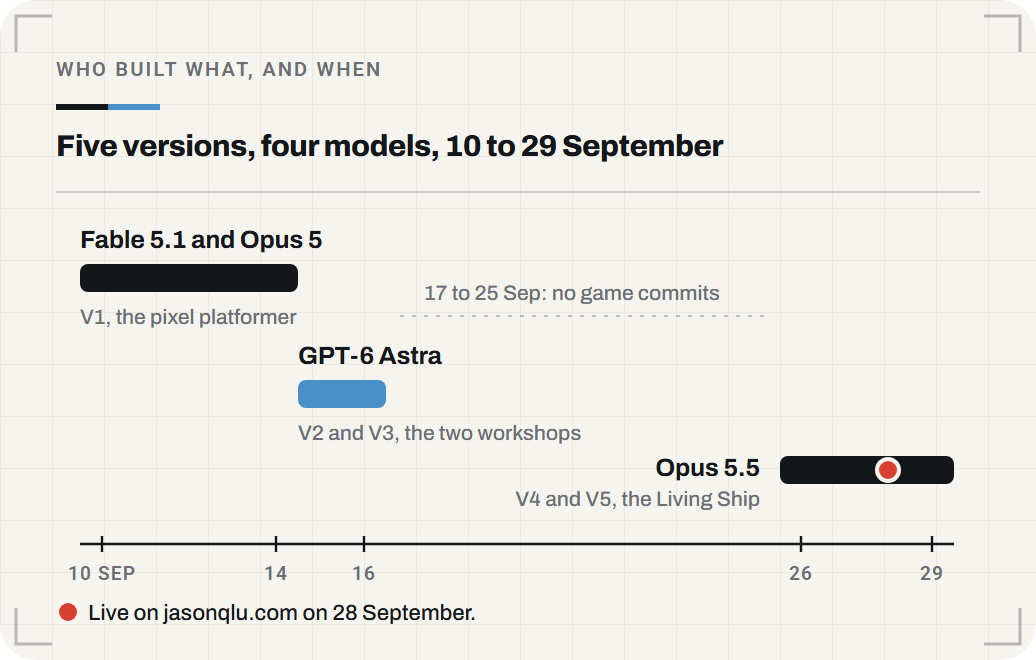
| Version | Dates | What it was | Built with |
|---|---|---|---|
| 1. Q and the Machine | 10 to 14 Sep | A pixel platformer with a brain in a jar | Fable 5.1 and Opus 5 |
| 2. The living workshop | 15 Sep | One brain, one bench, one order. An experiment | GPT-6 Astra |
| 3. The 3D workshop | 15 to 16 Sep | The first 3D version | GPT-6 Astra |
| 4. The first voyage | 26 Sep | The move to the sea | Opus 5.5 |
| 5. The Living Ship | 26 to 29 Sep | The open-world game, live on 28 September | Opus 5.5 |
The jump from pixels to an open sea had more to do with what the models could now do, and me wanting to push them, than with what the game needed. That's the bet in action.
What does the game teach?
Twelve parts over six voyages, each one a layer of a real AI system. The Oracle is the AI; the ship is the set-up around it.
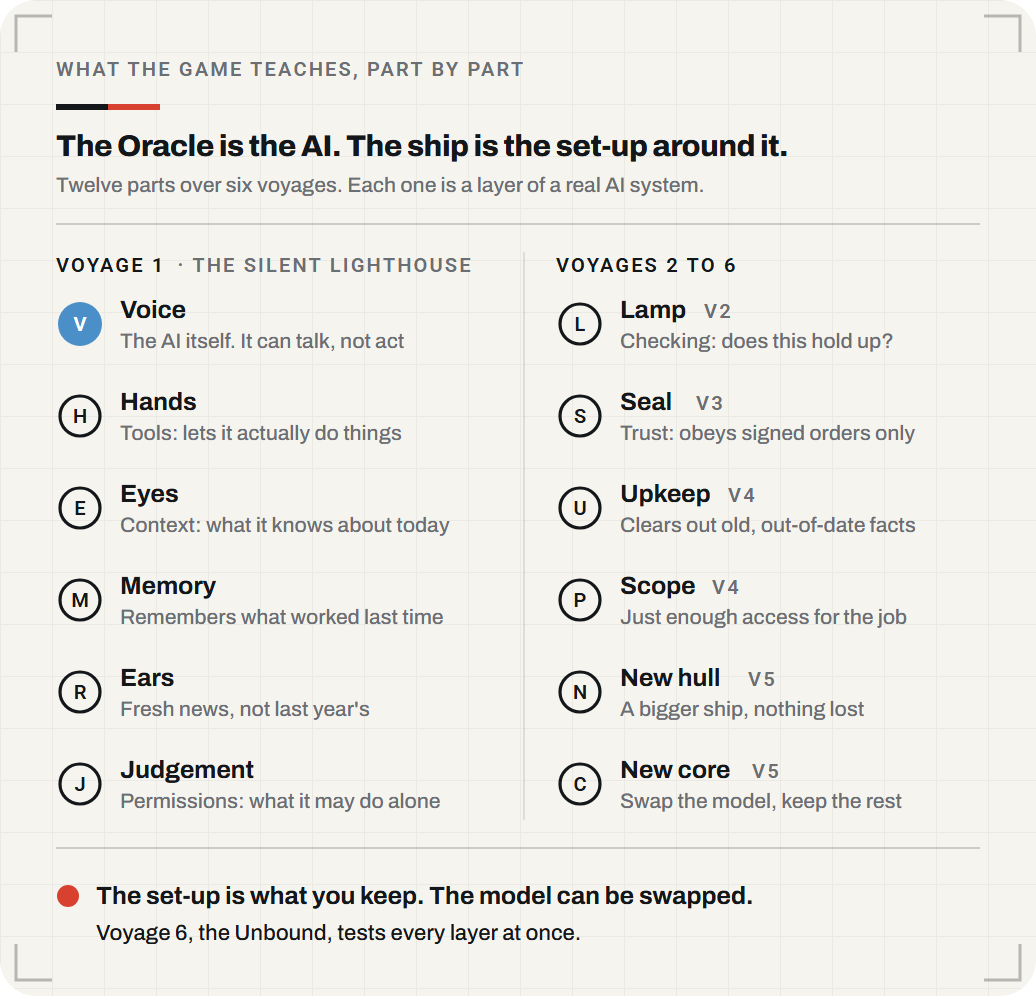
The game's last lesson is the bet itself: swap the model, keep the set-up.
What limits what you can build with AI?
You get back what you know how to ask for. Briefing an AI is like briefing a very fast builder. They'll build whatever you describe and won't tell you it's the wrong thing. My understanding of game development was the ceiling, so planning took about two weeks, and each version showed me what the game was really about.
Why should a company care about AI-built training games?
Games for learning aren't new. The speed is: I could describe an idea, play it within the hour and change it, without a studio.
A company's SOPs (its written step-by-step guides) could become onboarding games the same way. I don't think we're there yet, but it's getting closer. My course is one test, on my own material. I haven't tried someone else's SOP, and a generator would need to bring the game design too, which I found hardest.
What didn't work?
Fun and learning pull against each other. I just want to explore the sea. The lesson tasks can be cumbersome, and they get in the way.
I also swapped real AI terms for pirate ones: the AI became the Oracle, and checking its work became a lamp. It's like a training course where every job title becomes a pirate rank: fun, until you need the translation table. Every card explains the real term, and it still confuses.
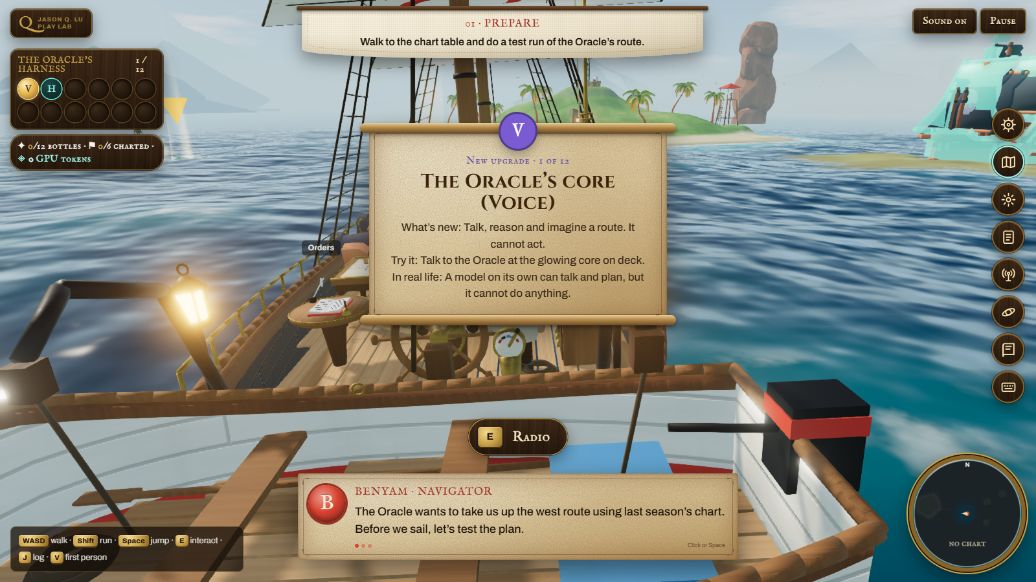
Every upgrade card ends with what it means in real life.
I haven't yet tested whether it teaches: six questions, before and after, with people who've never heard of an AI OS. That's next, and I'll report what it says either way.
What did it cost to build the game with AI?
| Opus 5.5 | GPT-6 Astra | |
|---|---|---|
| Run in | Claude Code | Codex |
| Text processed | 1.36 billion tokens | 30.3 million tokens |
| Text written | 3.7 million tokens | 171,484 tokens |
| Cost at list price | $408.99 | $47.37 |
A token is a chunk of text, about three-quarters of a word. "Written" is what the AI produced; the rest is text it read. That is about $456 in total at list price (the published pay-per-use rate), not counting version 1 or my planning time.
The surprise was where the money went. Between 62% and 66% of each bill was the AI re-reading the project, like a colleague re-reading the whole email thread before every reply. On long jobs, start a fresh session when the job changes.
Opus 5.5 figures cover one session plus its helper AIs, to 2:33 pm on 29 September 2026. Prices are from Anthropic and OpenAI, checked 24 September 2026.
Common questions
What is The Living Ship? A free browser game that teaches what an AI OS is. The AI is the Oracle and the set-up around it is the ship, which you build voyage by voyage across twelve parts.
How much did it cost to build a game with AI? About $456 at list price: $408.99 of Opus 5.5 in Claude Code and $47.37 of GPT-6 Astra in Codex, not counting the first version or planning time.
Can AI turn a company's training material into a game? Getting closer. I turned my own course into a game, but I haven't tried someone else's SOPs, and the game design was the hardest part for the AI to supply.
Why did most of the AI cost go on re-reading? Between 62% and 66% of each bill was the model re-reading the project before each step. Starting a fresh session when the job changes keeps that down.
The code behind the game is the subject of issue 08's article, and the model choice behind it is in what kind of model is GPT-6 Astra. If you would rather build a system than play one, the free course comes with the newsletter.
This started life as Build Notes Nº 07, in October 2026.
Want this mapped for your business? Book a 30-minute call.
More on how I work: AI consulting in Sydney, and what an AI consultant costs in Australia.
Get the next one
Subscribe and get the free course, Build Your First AI Operating System. Then a few emails a month on what I build, including what didn't work. See the course